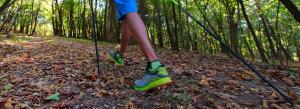
So What Exactly IS Nordic Walking?
Let's start with the basics, because I am an IT consultant after all, and we can never resist a proper definition before diving into the data.
Nordic walking is, technically speaking, fitness walking with specially designed poles. Not your grandfather's bamboo walking stick. Not those decorative trekking poles you bought from a Manali stall and used exactly once. Nordic walking poles are purpose-built, ergonomically designed instruments that transform an ordinary walk into a full-body workout. (More on the Stride poles we use and teach with, a bit later.)
The concept was born in Finland, those wonderfully stoic people who invented the sauna, heavy metal music, and apparently also the most effective low-impact exercise on the planet. Finnish cross-country skiers had a problem: no snow in summer. Their solution was elegant -- keep the poles, lose the skis, and just walk. For decades through the 1930s to the 1950s, Finnish ski coaches promoted this sauvakavely (pole walking) as year-round conditioning. The pivotal moment came in 1997, when Mauri Repo, a Finnish coach and physical education teacher, published a booklet formalizing the technique, and the company Exel Oyj designed the first dedicated Nordic walking poles. By 1999, Exel had coined and popularized the very term "Nordic Walking," and the rest, as they say, is history.
A history that took twenty-five years to reach our morning parks. But better late than never, yaar.
The Science Bit (I Promise to Keep It Interesting)
Here is where my IT brain gets genuinely excited, because the numbers are remarkable.
When you walk normally, you are engaging roughly 50% of your body's muscles, mostly everything below the waist. Your arms swing loosely, your upper body is essentially freeloading. Nordic walking, through the rhythmic planting and pushing of poles, activates up to 90% of your body's muscles. Your lats, traps, deltoids, triceps, pecs, and core all join the party simultaneously with your legs.
The metabolic consequence of this is, frankly, thrilling: Nordic walking burns anywhere from 18% to 67% more calories than ordinary walking at the same speed. Harvard Health confirms you are engaging 80-90% of muscles versus 50% in regular walking, providing a "substantial calorie-burning benefit". A published study found that oxygen consumption and heart rate are significantly higher in Nordic walking compared to regular walking, without any significant increase in perceived exertion. Translation: you work harder without feeling like you are working harder. As someone who has spent a career optimizing systems for maximum output with minimum resource consumption, I find this deeply satisfying. This is not walking. This is walking with a turbocharger.
A systematic review published in the British Journal of Sports Medicine concluded that Nordic walking "exerts beneficial effects on resting heart rate, blood pressure, exercise capacity, maximal oxygen consumption, and quality of life in patients with various diseases" and can be "recommended to a wide range of people as primary and secondary prevention". Another important finding: in cardiovascular endpoints, Nordic walking is superior to brisk walking without poles and, in some measures, even to jogging.
Superior. To. Jogging.
Let that sink in while you nurse your knee from your last run.
The Martial Arts and Yoga Connection (Bear With Me)
I have practiced martial arts and yoga for over fifteen years. My body has been repeatedly reminded, by various training partners and the occasional piece of floor, that it is no longer twenty-two years old. The thing about martial arts, whether it is kalaripayattu, karate, or the more recently acquired hobby of getting punched politely in the name of sparring, is that it teaches you something fundamental about biomechanics: the body works as a system, not as isolated parts.
A boxer's power comes from the feet, travels through the hips and core, and arrives at the fist. A kick in kalaripayattu begins with the planted foot and flows through the entire kinetic chain. The body is a connected instrument. Yoga teaches the same truth from a different direction: breath, alignment, and engagement are inseparable.
This is exactly what Nordic walking understands. The cross-lateral arm-and-leg movement, right arm forward with left leg, left arm forward with right leg, mirrors the natural contralateral pattern of human walking and martial arts movement alike. The poles do not fight this pattern; they amplify it. You push back with the pole at the exact moment your opposite foot strikes forward, creating a whole-body propulsion rhythm that is, mechanically speaking, beautiful.
When I walk with my poles in the early morning along the Netravathi river path, I can feel the same core engagement I get in a kata or a warrior pose. The shoulders rotate. The lats activate. The torso generates torque. Every step is intentional. Every step counts. This is not mindless shuffling behind a group of uncles discussing the Rajya Sabha elections. This is movement practice.
Why This Is Absolutely, Perfectly, Desperately Made for Indians
Now we arrive at the part where I get to be slightly smug and entirely correct.
The Diabetes Problem Is Real, and It Is Ours
India now has approximately 89.8 million adults with diabetes, making us second in the world, behind China. That is 10.5% of our adult population. Forty-three percent of them do not even know they have it. The ICMR INDIAB study counted over 10.1 crore cases. These are not abstract statistics. These are your chacha. Your neighbour aunty. Possibly you.
Nordic walking has been shown to reduce HbA1c levels, the key long-term blood sugar marker, significantly in people with Type 2 diabetes. Research confirms that Nordic walking improves glycemic levels, systolic blood pressure, physical fitness, and quality of life in older adults with T2D. The mechanism is elegant: engaging 90% of muscles activates GLUT-4 transport proteins, which pull glucose from the blood into muscle cells, essentially bypassing insulin resistance. A 20-minute Nordic walk after a meal can reduce post-meal glucose spikes by 30-40%.
Think about that the next time you are standing up after a family lunch involving three types of rice, two curries, papad, pickle, and dessert that appeared "just like that."
The Physical Inactivity Numbers Are Alarming
According to WHO data published in The Lancet Global Health, 49.4% of Indian adults do not meet recommended physical activity levels, a figure that has more than doubled from 22.3% in 2000 to 49.4% in 2022. If this trend continues, over 60% of India's adult population could be insufficiently active by 2030. The WHO's 2024 Physical Activity Factsheet for India confirmed this: 49.4% inactivity in adults, with women at 57.2% and men at 42%.
These numbers represent a ticking metabolic time bomb. Cardiovascular disease, Type 2 diabetes, obesity, depression, anxiety -- all of them have physical inactivity as a core contributing factor. And the solution does not have to be a gym membership you stop using in February. It can be poles and pavement.
The Joint Problem Nobody Talks About
Here is a polite truth about the Indian body in its 40s and 50s: our joints are not happy. Years of sitting cross-legged on the floor, squatting for various traditional purposes, climbing staircases without railings in buildings constructed with creative interpretations of architectural standards, and generally not prioritizing joint health catch up with us.
Nordic walking addresses this with elegant biomechanics. Every pole plant redistributes weight away from the knees, hips, and ankles. Cleveland Clinic notes that the "cumulative effect of that is less wear and tear on your ankles, knees and hips as you rack up miles". A study showed that Nordic walking improved sitting, climbing stairs and walking ability in patients with hip osteoarthritis significantly better than other training methods. Office workers who practiced Nordic walking for twelve weeks showed significant improvement in shoulder mobility and reduction in muscle tenderness in the trapezius, latissimus dorsi, and infraspinatus.
For those of us who spend nine to ten hours hunched over a laptop, and I include myself firmly in this category, that last fact alone should have you reaching for your credit card.
Our Morning Walker Culture Is Already Ready
India already has one of the most glorious morning walker cultures in the world. Go to any public park in any Indian city at 6 AM and you will find a magnificent cross-section of humanity: the power walkers with Fitbits; the philosophical strollers debating current events; the aunties in sarees who somehow manage four kilometers without breaking a sweat; the uncles doing inexplicable neck exercises; the yoga practitioners; the political gossip circles; and one very confused foreign tourist who wandered in from the hotel.
Dr. A Velumani, the scientist and entrepreneur, famously spent three years observing morning walkers in Coimbatore parks and categorized them: roughly 20% actively fitness-focused, 50% health-compelled adults managing chronic conditions, and a philosophically intriguing 30% there for entirely different hormonal reasons. The point is: we already go to parks. We already walk. We just need to walk better.
Nordic walking plugs directly into this existing cultural behaviour. You do not need a gym. You do not need special footwear beyond comfortable athletic shoes. You just need the right poles and a 500-meter stretch of walkable ground. The Government of India's Fit India Movement and even the Delhi LG have recently directed parks to remain free for morning walkers till 10 AM, a policy that makes Nordic walking infinitely more accessible.
The Physiotherapy Angle: Why Doctors Should Be Prescribing This
Speaking as someone who teaches Nordic walking and has done enough research to occasionally annoy actual physiotherapists at dinner parties, I want to make a specific case for Nordic walking as a clinical and rehabilitation tool.
Cardiac rehabilitation: Studies in people with heart disease show Nordic walking programs produced significantly improved exercise capacity, duration, and oxygen uptake compared to standard cardiac rehab programs. A study in 135 people with coronary artery disease found Nordic walking led to greater improvements in functional capacity compared to both HIIT and moderate-intensity continuous training. This is not a fringe finding. It is a consistent, replicated result.
Parkinson's disease: Physiotherapist Bhanu Ramaswamy from Parkinson's UK has documented how Nordic walking helps patients maintain better posture, take longer strides, and improve coordination. Patients report being able to walk uphill more easily, go shopping independently, and even visit the seaside, activities they had resigned themselves to losing. The poles create a rhythmic external cue that helps bypass the Parkinson's-related disruption to gait initiation.
Fibromyalgia and chronic pain: Experiments have shown Nordic walking has rehabilitation effects on fibromyalgia and improves functional capacity. A 2024 systematic review in the NIH's PMC confirmed beneficial effects in six of eight studies examining Nordic walking and fatigue, and six of nine studies on pain perception.
Postural control and balance: A 12-week Nordic walking program had a positive impact on gait parameters and postural control in women aged 65-74. In a country where fall-related injuries in the elderly represent an enormous but under-reported healthcare burden, this matters enormously.
Office worker syndrome: A 12-week Nordic walking routine improves shoulder mobility and reduces tenderness in key office worker problem areas: upper and mid trapezius, latissimus dorsi, infraspinatus. For India's rapidly growing IT workforce, where cervical spondylitis has practically become an occupational hazard, this is borderline prescriptive.
Doctors in Germany and Scandinavia already prescribe Nordic walking courses for knee and hip arthritis patients. Indian physiotherapists, I respectfully submit, might consider doing the same.
How to Actually Do This: The Practical Guide
Let me now earn my keep as both a practitioner and a Nordic walking instructor.
Getting the poles right: The standard formula is simple: multiply your height in centimetres by 0.68, then round to the nearest 5 cm increment. At 90-degree elbow flexion with the pole tip on the ground, your forearm should be parallel to the floor. If you are between sizes, choose the smaller size for comfort and the larger for more propulsion.
For the average Indian height range of 160-175 cm, you are typically looking at 110-120 cm poles. We designed the Stride pole model specifically for Indian conditions: the right grip diameter for Indian hand sizes, a tip suited for park paths and paved roads, and a weight that won't tire your arms before your legs get their workout. It is the pole I use every morning and the one I put in the hands of every person I teach. More details on Stride poles are available on our website.
The technique in four steps:
- Drag phase: Strap the poles to your wrists and just walk normally, letting the poles trail behind you at about 45 degrees. Do not grip them. Do not wave them around. Just let them drag and get used to the rhythm.
- Pendulum phase: Increase your walking pace slightly and start swinging your arms in the natural opposite-arm-opposite-leg pattern. The poles will begin planting themselves naturally. Keep your chin up, shoulders relaxed, and feel the rhythm.
- Plant and push: Now grip the pole lightly as it plants, and push back through it, as if you are launching yourself forward. The key word is push back, not lift up. After the push, open your hand and let the pole swing forward again via the wrist strap. This open-hand technique is important; it also stimulates nitric oxide production, improving arterial blood flow.
- Full engagement: Roll from heel to toe on each step, lengthen your stride, and let the poles create propulsion. You should feel your lats engage. You should feel your core activate. You should feel like you are walking 15-25% faster than usual, because you probably are.
Common mistakes to avoid: Do not plant the pole in front of you (it should go beside or behind your lead foot, never ahead of it). Do not hunch. Do not death-grip the poles; keep your hands relaxed between plants. Do not jab the ground like you are angry at it. Think propulsion, not stabbing.
In our Nordic walking classes, we spend the first session entirely on the drag phase. People want to jump ahead, especially the IT crowd used to reading documentation and skipping to the implementation. Resist that urge. Get the rhythm right first, and everything else follows naturally.
Addressing the Aunties-and-Uncles Problem
I know what some of you are thinking. You are thinking: "Yaar, walking with sticks? People will think I am old and infirm."
To which I say: are you walking 90% of your muscles while they walk 50%? No? Then who is actually old and infirm?
The perception problem is real, I acknowledge it. But let me offer some re-framing. We live in a country where people do surya namaskar on railway platforms, practice yoga at traffic stops, and run through airport terminals in formal wear while pulling a suitcase. We are not a self-conscious people when health is concerned. And once your park companions see you consistently looking more energised, maintaining better posture, and losing weight while walking, not jogging, walking, they will ask questions. And you will tell them.
Also, practically speaking: in Bangaluru, Chennai, Pune, Mumbai, Delhi, in any city with reasonable parks and pavements, you can Nordic walk without anyone looking twice for more than about two weeks. By week three, someone in your morning group will be curious. By month two, you will have started a small movement.
This has happened in the West. It started happening in Japan and China. It is beginning in India, with physiotherapy practitioners and fitness researchers starting to advocate for it. The tipping point is close. I have seen it in every batch of students I have taught, the moment they finish their first proper pole-assisted walk and feel the difference in their shoulders and energy levels. That moment converts people.
A Word on Who This Is Especially For
While Nordic walking genuinely suits everyone from competitive athletes (it is still used as off-season training by Scandinavian skiers) to complete beginners, there are specific Indian demographic groups for whom it might be transformative:
- The 40-60 age bracket with early osteoarthritis, diabetes, or cardiac concerns who need exercise but need it joint-safe
- IT professionals with cervical and lumbar spine issues, rounded shoulders, and chronically tight trapezius muscles
- Post-cardiac rehabilitation patients who need graded exercise that is clinically validated
- Elderly individuals who need improved balance, gait speed, and fall prevention
- Women in perimenopause and menopause, where bone density, joint health, and cardiovascular risk all converge -- Nordic walking addresses all three simultaneously
- People with Parkinson's disease who benefit from the rhythmic, coordinated full-body movement
The Bottom Line (From Someone Who Does This Every Morning)
I wake up at 5:45 AM. I slip into my walking shoes, pick up my Stride poles, and head out. The Bengaluru air at that hour is cool. The streets are mostly quiet. The trees are doing their tree things.
And I walk. Properly. Every muscle from my calves to my lats engaged. Shoulders rotating. Core active. Heart rate elevated to the aerobic zone without my knees registering any complaint. By the time I return forty-five minutes later, I have burned the caloric equivalent of a light jog, worked every major muscle group, and cleared my mind with the particular efficiency that only rhythmic outdoor movement provides. Then I open my laptop and write code. The code is better for it. (Unverified claim, but I am sticking to it.)
Nordic walking is not complicated. It is not expensive. It does not require a gym membership, a trainer, special terrain, or a particular time of day. It requires two poles, a pair of comfortable shoes, and the willingness to look slightly unusual for about two weeks until it becomes your favourite thing.
India has the parks. India has the morning walking culture. India has, unfortunately, the epidemic of diabetes, cardiac disease, and metabolic syndrome that makes vigorous but joint-safe exercise a genuine public health priority. The math is not complicated. This is the kind of engineering problem where the solution is already proven and just needs deployment.
Get the poles. Pick up a pair of Stride poles if you want to start right. Come to one of our classes if you want to learn the technique properly. Hit the pavement. Walk like a Finn.
Your joints will thank you. Your cardiologist will be pleased. And that retired army colonel near the banyan tree? He will eventually ask you where to buy the poles.